6-Month Savings Plan for Your Dream Vacation: Ultimate Guide

Taking a planned vacation offers significant benefits. According to the American Psychological Association, time off helps U.S. workers recover from stress and improve well-being and job performance. However, the positive effects often dissipate within a few days of returning to work.
(apa.org) Despite these benefits, many Americans forgo vacations due to financial concerns. A 2022 survey found that 56% of adults don’t believe they can afford a vacation this year. (studyfinds.org). The good news? With proper planning and a strategic six-month savings approach, your dream vacation is attainable. Whether you’re envisioning pristine beaches, historic cities, or mountain adventures, this guide will help you create a personalized six-month savings plan that works. Start your Dream Vacation Budget now!
You may also like this:

Why a 6-Month Timeframe Works Best for Vacation Saving

Timing is crucial. A six-month savings plan strikes the perfect balance between immediate gratification and sustainable financial habits. Financial goals under 3 months often fail due to pressure; those over 8 months tend to lose momentum.
(zacks.com)
Behavioral economists say it takes about 4–5 months to cement new habits, making six months ideal for building lasting financial discipline.
(blog.harvardfcu.org)
Break your savings into 26 weekly or 6 monthly contributions to make your goal more manageable.
Setting Your Dream Vacation Budget: Breaking Down All Costs

A comprehensive vacation budget is your foundation. Without it, you risk unpleasant financial surprises.
Research these core categories:
- Accommodations: Mid-range hotels in the U.S. average $171/night, peaking around $318 in high season.
(budgetyourtrip.com) - Local Transportation: Public transit, rideshares, or car rentals—budget accordingly.
- Food: The USDA suggests $302.80/month per adult, or around $10/day.
(fns.usda.gov) - Activities/Tours: Range from $25–$200+ depending on type and location.
Don’t forget hidden expenses:
- Travel Insurance: Typically 4–6% of your trip cost.
(forbes.com) - Pet Boarding: Averages $25/day.
(homeguide.com) - Special Gear/Clothing: Depends on destination and activities.
Transportation to your destination can consume 55% or more of total vacation cost.
(quizlet.com)
Add a 15% contingency buffer for unexpected costs.
(fastercapital.com)
Use free tools like the Travel Budget Calculator:
(calculatorcorp.com)



Determining Your Monthly Savings Target

Start with your total budget, subtract any existing funds, then divide by six.
- Example: A $3,000 trip = $500/month for 6 months.
Ensure this amount fits your income. Most savers allocate 5–8% of monthly income to travel. If your target exceeds 10%, extend your timeline or adjust your itinerary.
Use a visual savings tracker to stay motivated—these tools increase success rates.
(blog.harvardfcu.org)
Finding Money in Your Current Budget
A spending audit is the first step. Review your past three months of expenses.
- Subscription services: Americans average $219/month.
(crresearch.com) - Food Spending: Cut takeout by just 2 meals/week = save $200+/month.
- Use the 72-hour rule: Wait before making purchases over $50 to decide if you’d rather use that money for vacation.
The most effective tip? Automate savings. Set up automatic transfers right after payday for your vacation.
(blog.harvardfcu.org)
Creative Ways to Boost Your Vacation Fund

To accelerate savings, combine cutting costs with increasing income:
- Side Hustles: 10–15 hours/month can generate $300–$500. Options include:
- Tutoring: $25–$50/hour
- Pet Sitting: $20–$35/hour
- Freelancing: Use your professional skills
- Decluttering: Average homes contain $4,500 in unused items. Selling even 20% can fund a big portion of your trip.
- Reward Hacking: Use travel rewards credit cards to earn $300–$600 in points without extra spending (only if you pay the balance in full before the due date)
- One-Time Boosts: Use tax refunds, holiday bonuses, or gift money to give your fund a lift.
Setting Up a Dedicated Vacation Savings Account
Use a separate account to avoid dipping into your vacation fund.
Look for:
- High-Yield Savings Accounts (HYSA): Earn 3.5–4.5% APY (as of 2025)
- No monthly fees
- Automatic transfer options
- Withdrawal restrictions (like Vacation Club Accounts) to prevent impulsive spending
Apps that round up purchases can contribute $30–$45/month.
Month-by-Month Savings Plan Breakdown
Structure keeps you motivated. Here’s a simple outline:
- Month 1: Track spending, find 3 cuts, make your first transfer.
- Month 2: Refine budget, increase auto-saves, launch side hustle.
- Month 3: Stay focused—this is often the hardest month.
- Month 4: Use a tax refund or sell unused items to stay ahead.
- Month 5: Revisit your travel budget. Book airfare or accommodations.
- Month 6: Final push! Confirm reservations and enjoy seeing the results.
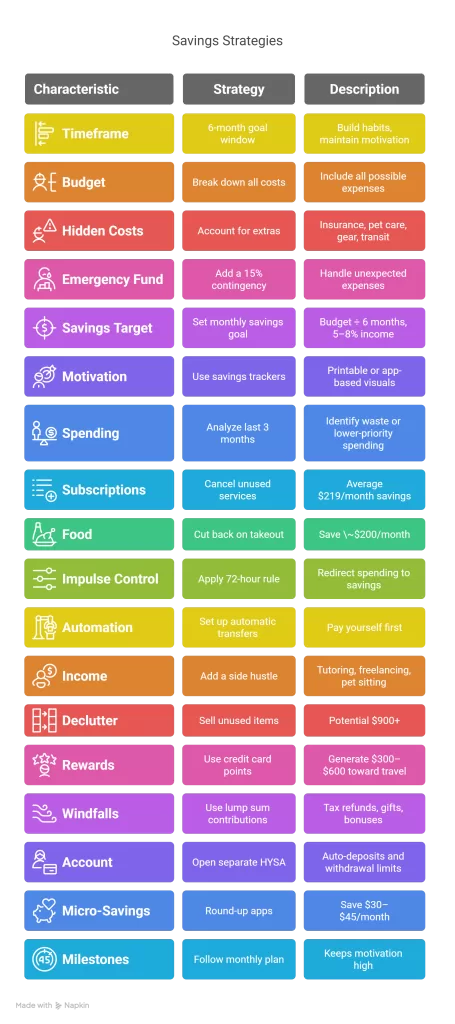
🌍 6-Month Vacation Savings Plan — Quick Tips Table
Conclusion
With this strategic 6-month savings plan, your dream vacation transforms from a distant wish to an achievable reality. Remember that the discipline and habits you develop during this process extend far beyond a single getaway—you’re building financial skills that will serve you for life. The memories and experiences from your well-earned vacation will provide lasting value that far exceeds the temporary sacrifices made to get there. Start your 6-month journey today, and by this time next year, you’ll be sharing stories and photos rather than still dreaming about “someday.” What destination will you be saving for first?